Broken Skipper—Part I, What Happened
by JOHN on NOVEMBER 18, 2012 · 4 COMMENTS
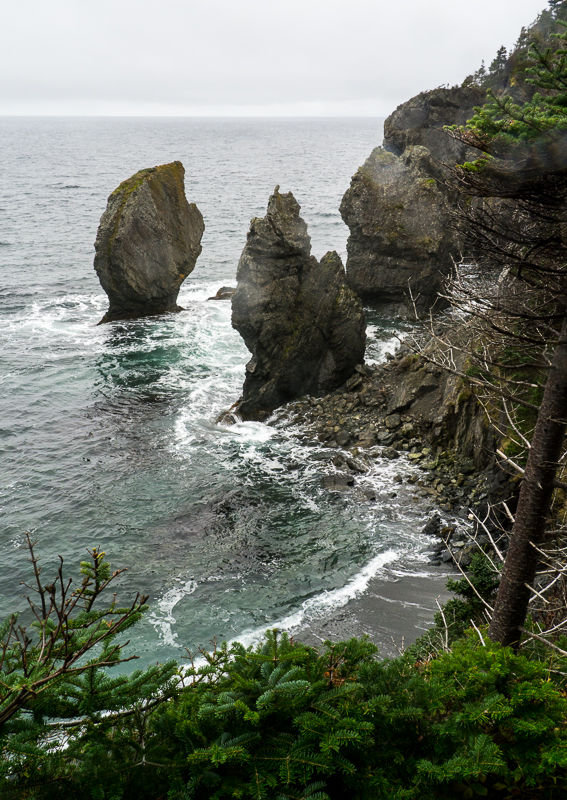
Sea stacks on the Skerwink Trail, taken a short while before the accident.
Like most voyaging couples, I suspect, Phyllis and I have long feared one of us getting seriously injured as the ultimate risk, short of death, facing us. This fear has always been especially prevalent during our Arctic voyages; who knew that it would be realized so close to home.
As many of you know, I fell and broke my leg while hiking in Newfoundland. And while we were traveling by car at the time, most of what happened in the next few hours would have been the same if the accident had occurred while we were cruising Newfoundland on Morgan’s Cloud. We did some things right, some wrong, and learned a huge amount. I will try and share some of these lessons over a series of posts though it may take me awhile since this short post took four days to write, typing with one finger on an iPad in short bursts through a fog of pain killers.
What Happened
Phyllis and I were hiking a short, but spectacularly beautiful, trail around a headland in Newfoundland. The weather was relatively warm and settled though the trail was very wet in shaded areas. We would classify the trail as easy on our scale, which admittedly has been calibrated by many years of hiking and near-climbing in the North.
While descending a short flight of “wilderness stairs” constructed from on-site sourced tree trunks and branches, my feet slipped out from under me and I fell several feet landing with my full weight on an about four-inch diameter trunk set vertically into the ground to anchor one end of the stair-tread, thereby crushing and breaking my femur just below my hip joint.
Phyllis called for help on our cell phone and within 30 minutes two young men, both wilderness first aid trained, had arrived, quickly followed by members of the local volunteer fire department, an EMT, and a member of the local RCMP detachment. After assessing my condition, the EMT and RCMP member called for a helicopter evacuation. This was rejected higher up the chain of command, a decision that is currently under review.
The rescue team then finished the excellent stabilizing job that Phyllis had done and strapped me on to a back board before carrying me over two kilometers of rough terrain to a beach where I was loaded onto a fishing speedboat for a short trip across the bay to a waiting ambulance.
This whole process took about four and a half hours. It took a further hour in the ambulance to reach the regional hospital and the warm embrace of my first dose of analgesics. So, while this was may not have been a wilderness accident in the strict sense of that term, the time to hospital was well into the duration that could be expected in a real wilderness emergency.
It will be hard for anyone not on-scene to imagine what an incredible feat evacuating me through the tangled mess of scrub spruce and slippery uncertain footing was. One mistake or moment’s inattention could have had fatal consequences for me. I owe those men and one woman a huge amount and quite possibly everything I will ever have: In the bush a femur break is one of three frequent killers (the other two are head injury and heart attack).
In the next post, we will look at some things we did right.
Broken Skipper—Part II, What We Did Right
by JOHN on NOVEMBER 24, 2012

The Carry Out. Photo kindness of Luke Fisher
In the last post I covered the story of my accident. In this one I’m going to go over some of the things we did correctly, both before and after the accident:
Clothing
As is our habit whenever we hike, we were both dressed right, not only for the prevailing conditions but for any deterioration in the weather or the need to be stationary for some time: Smart wool and capilene next to the skin, a quick drying layer over that, topped with fleece. In the pack were Gortex outer layers, gloves and warm hats.Even though my rescue took over four hours, neither of us was ever really cold, albeit in my case thanks in part to the blankets brought by the rescuers. The story could have been different if we had been wearing the jeans and tee shirts you see so often on the trail. Cold and shock are a dangerous combination. Probably not life threatening in this case, but it is not for nothing that Yosemite Mountain Rescue call cotton “death cloth”.
First Aid Kit
Even though the trail was comparatively short, we were carrying a full wilderness level first aid kit. We only used one item, but, as we shall see, that was vital.
Good Comms
We were carrying a CMDA cell phone, which Phyllis used to call for assistance. Had the phone been GSM, she would have had to walk out for help. That we had the right phone was no accident. We had selected our phone based on our intended area of travel. The phone also contained a GPS and I had loaded a topographical map of the area on to it. Both helped Phyllis explain exactly where we were.
By the way, even if your GSM phone is theoretically capable of using a CDMA signal, like the new iPhones, don’t assume that your carrier will actually let you do so, many block this feature. Test before you go.
If we had been in an area with no cell service we would have been carrying our personal rescue beacon, as we did in Greenland and Baffin Island last year. However, after this event, I will seriously consider carrying our Iridium phone when out hiking in wilderness areas. We, like many voyagers, own a satellite phone for weather reception and email, and the newer ones, like ours, are little bigger than the cell phone of a few years ago; so why not carry it? The benefits of actually being able to explain your emergency to rescuers are hard to overestimate.
We have the numbers of the relevant rescue coordination centers programmed into the Iridium on speed dial.
Wilderness First Aid Training
Last year we did a wilderness first aid course. This training may have saved my life since it enabled us to evaluate the injury (femur break) and immediately understand that we had a life threatening situation on our hands.
Using our training, we made the decision, before I stiffened up, to move me a few feet to a more stable position and at the same time get me on top of the plastic tarp that we were carrying in the first aid kit. Not only did this assist us in keeping me warm, by separating me from the cold damp ground, but the tarp was a vital part of moving me onto the back board without further damage for the carry out.
Also, being trained gave us immediate credibility with the rescuers, so that when we said what was broken and that I was already partially stabilized, they believed us. And it was interesting to note that the several people in the rescue group that were wilderness first aid trained were the ones that instinctively understood the situation.
It is really important to understand that wilderness first aid is very different than general first aid training. If you spend several days in a classroom being PowerPointed to death, getting a first aid certification, you are simply not qualified for the wilderness.
Real wilderness first aid training takes place in the woods, preferably in the dark with rain and black flies. You are presented with horrible scenarios with your fellow classmates acting as screaming, shivering, blood covered victims and you must make decisions in a world where there are no clean right and wrong answers, just common sense and probability—much like being at sea. It is, in my opinion, the very best training for cruisers.
Have the Right Partner
Phyllis was absolutely calm and competent throughout the whole ordeal. She sat motionless in an awkward position stabilizing my leg for over two hours in a situation where even the slightest movement produced screams from me—I did not suffer in silence. And her reassurance kept me going, even in the blackest moment when I realized that I was to be carried out on a board through rough terrain with no analgesics.
Thank you, My Love.
In the next post, I will write about one big mistake that I made
In the next post, I will write about one big mistake that I made
No comments:
Post a Comment