8 Tips For a Good Voyaging Boat Interior Arrangement

Interior arrangement of the Boreal 44, kindness of Jean-François Eeman
I’m working on the specification for the Adventure 40 interior arrangement and that process has got me thinking about what design criteria go into making a good voyaging boat interior.
This is an area where I feel that I’m well qualified since, so far, I have spent approximately 30% of my 61-years living afloat and most of that while actually going places. So here are my thoughts:
Tip #1, Hull Form Wins
The biggest mistake in boat design today—all boats, it’s even worse in the displacement motor boat arena than it is in sailboats—is distorting the hull to fit in a large interior for a given length. Yes, I know the salesmen will tell you that their designers have figured out a way to do this and still have a good offshore boat. It’s not true.
The fundamental principles of boat design, that have been known for decades, that govern what hull forms will be comfortable and efficient at a given speed to length ratio and in a given sea condition, cannot be stretched or changed, they just are.
What does this mean? Simply that if the interior of a boat we are considering is not big enough for our requirements, we need to either change our requirements or buy a bigger and therefore more expensive boat—there is no third option.
By the way, it’s important to understand what bigger means and that it has absolutely nothing to do with overall length. This post explains the parameters that govern boat size.
Tip #2, Long Thin Boats Have Better Offshore Interiors
And if our interior requirements push us into a bigger boat, it is almost always better to make the boat longer, within reason, rather than fatter. Not only will the boat be faster, more efficient and more comfortable offshore, it is easier to design a good and efficient interior for a long boat of a given displacement than a fat one.
Here’s an example that demonstrates why this is. Say we want, on one side of our boat from aft to forward:
- 4-feet for a good sized lazarette,
- 7-foot cockpit,
- 7-feet for a nice U-shaped galley,
- 7-foot sea berth,
- 2-foot hanging locker,
- 7-feet for a V berth,
- 5-feet for chain locker and forepeak.
That totals out at 39-feet.
And let’s say that our budget allows for a 19,000 pound boat. You can make a boat of that displacement 40 feet long, but she will be relatively thin with fine ends, if you want a good sea-kindly hullform. Or you could make her as little as 32-feet long, but much fatter.
Clearly making the boat shorter than 40-feet means that something must go in the above list—you can’t stick the V berth in the middle of the salon. So the short fat boat costs the same, but has less usable and useful space. This is why the current fashion of advertising “the most interior for a boat of a given length” is, well, just plain stupid.
Yes, I know that short boats are cheaper to keep alongside, but I’m writing about voyaging boats here that don’t spend much time in marinas. And incidentally, if you really do some miles, like we do onMorgan’s Cloud, the added efficiency of a long boat when under power will pay most, or even all, of the additional marina charges. And this goes double for those of you with motorboats.
Tip #3, A Pint in a Quart Pot

“Morgan’s Cloud’s” cavernous forepeak. To give you an idea of scale, that’s the end of our vane gear to starboard and the storm trysail to port.
Once we understand that good hull form is sacred, the next most important thing to keep in mind when designing an interior arrangement for an offshore boat is that we will be much happier out there cruising if our boat has less interior amenity and more storage than almost all boats sold today.
For a graphic demonstration of what I’m talking about, go below on just about any boat with a modern boat-show-interior that’s really out there cruising. Note the guest cabin stuffed with fenders, spare sails, deck gear, buckets, boarding ladder and spare anchor(s). Ditto those nice quarter berths. Check out the stall shower that is stuffed with safety and foul weather gear near to the top. Neither shower nor guest cabin ever get used because it takes an hour at hard labour to clear them of stuff, and then where the hell do the crew put it all?
Also take note of all the dings and scratches in all that lovely varnished wood from wrestling all that stuff in and out of spaces that were designed to sell boats, not store heavy sharp-cornered stuff. Doesn’t do the crew’s backs any good either.
One of the features that makes our own Morgan’s Cloud such a great live aboard voyaging boat is that her interior is not pushed out to each end of her hull. The consequence is that all of that gear is where it belongs: out of the accommodation and stowed securely in her cavernous lazarette and forepeak.
Shush, Phyllis! She was about to tell you about the quarter berth stuffed full of my camera gear.
Tip #4, Falls Suck
I always knew that it was important not to fall at sea, but as part of ourstaying aboard series I just learned from some climbers—thank you guys—that a free fall of just two feet can subject your body to as much as 20 newton meters of force if you come to a sudden stop. To put that into “old money”, it is roughly equivalent to a force of two tons. Trust me, that stings.
I will certainly think about that the next time I’m below on a boat-show-boat and the salesperson is waxing lyrical about the lovely open airy spaces. Those same spaces could maim or even kill me or someone I love when at sea.
And a few hand holds are not enough to keep us safe if we have large open spaces. Why? I don’t know about you, but I can’t do a one armed pull up, or even close. So I have little faith that I could hold even half my body weight against the accelerations—I have been momentarily weightless at sea many times over the years, indicating an acceleration of over 1G, which will be 2G on the other side of the cycle—in a voyaging boat at sea in heavy weather, even when holding on with both hands. Maybe fear would make me super-strong for the moment that mattered, but I don’t want to bet my body on it.
The key to being safe, as any climber will tell you, is to reduce the potential fall distance to almost nothing, and that means narrow spaces with plenty to lean on. By the way, that’s just another reason why long thin boats make way more sense at sea than short fat ones.
Tip #5, A Good Place to Sleep
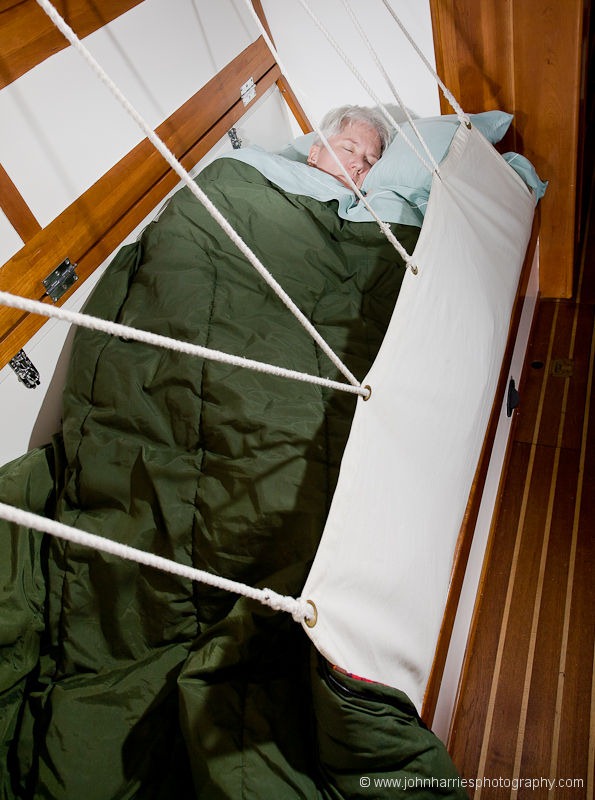
It just stuns me that boat builders are now selling boats as offshore capable that do not have one single berth that will be comfortable and safe at sea. Colin and Phyllis have already detailed what constitutes a good sea berth, so I won’t repeat that here.
Tip #6, A Few Big Spaces Work Better Than a Lot Of Small Ones
This will sound like a contradiction of tip #4, but it’s not. It is generally better to make a single space for a given purpose that is larger, functional and has good access, than multiple smaller ones.
For example, putting two heads in a 24,000 pound (11,000 kg) boat generally results in two spaces that require the skills of Harry Houdini to perform a natural and frequent function. So unless you have a large family, or a teenager, it’s much better to have one head that is comfortable and functional with plenty of storage and maybe even add a separate shower stall too—one of the most underrated luxuries in boat interior design.
Another example, you really can’t do three sleeping cabins well andhave enough storage space too, until you get to about 55,000 pounds (25,000 kg) displacement, and that’s a big boat, bigger than ourMorgan’s Cloud.
Tip#7, Somewhere to Fix Stuff

Boats that are going offshore voyaging need a workbench, no matter how small, with a vise. One good way to achieve this is to follow Colin and Louise’s good example and convert a second aft cabin into a utility cabin, or even tear out a quarter berth, to accomplish this.
Tip #8, Access is King, Queen and Grand Poobar
One of the most important things we can do in offshore boat design that will increase the crew’s enjoyment of voyaging, perhaps more than any other, is to make sure that there is good access to every mechanical contrivance, every pipe and every wire on the boat so we can get to it when it goes wrong—note I said “when” not “if”. And the way to do that…yes, you guessed it, is not to stuff too much interior into the boat.
In fact, Steve Dashew tells me that he regularly saves money on the boats he designs by making them bigger because the savings from the ease of equipment installation outweigh the additional cost of a bigger hull. Of course that only works if you can prevent the owner from filling the additional space with more interior. And if you think that can’t be done…well, you don’t know Steve!
One other detail in this area: Putting wooden bungs over the screw heads that hold an interior together is a poor idea, ditto gluing said interior together, so that removing parts of it to get access requires a crow bar, and then a new interior.
Boreal 44
The graphic above shows the innovative interior of the Boreal 44 that deals well with the challenges provided by lifting keel boats due to the need to accommodate the centerboard case. Note that the plan does not show the huge lazarette.
If we were having a Boreal built—now there’s a fun thought—I would go with the two sleeping cabin option and convert the saved volume to storage along with a small work bench. I would also ask Boreal to do away with one of the heads, like Colin suggests here.
How Do I Get a Boat Like This?
So how can you own a boat that incorporates all these tips? That’s a challenge. There might be a few around in the second hand market, but very few. Boreals are good, and you could specify a Wylo to conform to the tips in this post. And we are working on a third alternative.
Checkout the great comments: http://www.morganscloud.com/2013/05/12/8-tips-for-a-good-voyaging-boat-interior-arrangement/#comments
FOR "GG" WE WOULD NOT CHANGE FROM OUR SALON/GALLEY UP PILOTHOUSE WITH TWO STATEROOMS AND TWO FULL HEADS WITH A NEAR STAND-UP FULL WIDTH HUGE MACHINERY ROOM. THE STERN FULL WIDTH (NO LAZARETTE) STATEROOM IS THE MASTER WITH AN ISLAND QUEEN BERTH WHICH IS APPRECIATED EVERY NIGHT. THE FORWARD STATEROOM HAS FOUR-BUNKS WITH THE LOWER BUNKS CONVERTING INTO A LARGE DOUBLE V-BERTH USING AN INSERT. THERE IS A TOOLBOX AND 9 CU FT DEEP FREEZER WORK SPACE AFT OF THE ENGINE ROOM OPPOSITE THE AFT HEAD.
IF WE WERE TO BUILD A NEW BOAT I'D ONCE AGAIN USE A BASIC SAILBOAT HULL LIKE A BRUCE ROBERTS 52-58 SPRAY PILOTHOUSE WITH TRUNKED WALK AROUND DECK - SEE http://www.bruceroberts.com/public/HTML/S58.htm.
I WANT A SHALLOW DRAFT YET DEEP OCEAN CAPABLE VESSEL - ADD A FULL BOX KEEL WITH PROTECTION FOR PROP AND RUDDER - I'D ALSO THINK ABOUT PLACING THE SHAFT AND PROP IN A TUNNEL DESIGN TO INCREASE SHALLOW WATER CAPABILITY. ENTER A RETRACTABLE OR SWING KEEL SECTION - SEE THESE IDEAS:
http://www.steynor-keel.co.uk/index.php/site/description/
http://www.seawardyachts.com/index.html
http://www.seawardyachts.com/keel.html
http://www.nytimes.com/1999/04/25/sports/boating-report-swing-keels-now-available-for-recreational-use-too.html
http://www.sirius-werft.de/phpwcms/index.php?id=587
http://www.mackenzieboating.com.au/pdf/LiftKeelArticle.pdf
http://www.swingkeelsailing.com/wordpress/wp-content/uploads/2012/05/Seahorse-Article-June-2012.pdf
http://stadtdesign.com/designs/stock_plans_sail/madeira_44/6
http://www.gurit.com/files/documents/Sink_or_Swing_-_The_Fuindamentals_of_canting_keel_structures.pdf
http://www.macgregor26.com/drawings/drawings.htm
http://sponbergyachtdesign.com/Bagatelle.htm
Prop Tunnels - would modify and also add keel(s) with drop-down or swing section...

And the list goes on....
QUESTIONS?
No comments:
Post a Comment