The onset of winter brings frequent cold outbreaks across the central and eastern US that can often result in gale to storm force winds over the Gulf of Tehuantepec.
I first heard about the Gulf of Tehuantepec gales from my father who sailed with the United Fruit Company’s Great White Fleet during the late 1940’s and 1950’s. The Gulf of Tehuantepec gales are strong northerly winds that funnel through gaps in the Sierra Madre Mountains and spill out over the Gulf of Tehuantepec along the south coast of Mexico during the winter season.
The Sierra Madre extend southeastward through Mexico and Central America and separates the Gulf of Mexico, the Bay of Campeche´ and Caribbean Sea from the Pacific Ocean. Several mountain gaps allow air to flow across Mexico and the most prominent gap is the Chievela Pass which allows strong cold air surges to pass into the Gulf of Tehuantepec on average about 15 times each winter season with about 2 of these strong enough to reach storm force conditions.

The winds are produced when there is a strong pressure gradient between the Gulf of Mexico to the north and the eastern North Pacific to the south. Northerly winds can increase to storm or even hurricane force during the more extreme events. The first event of each cool season normally occurs in mid-October with the last event occurring in late March or early April.
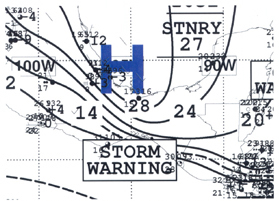

At the outset of gale events, surface pressures reach a maximum value of about 1028mb at Brownsville and 1024mb at Coatzacoalcos. During storm events the pressure at Brownsville are about 4mb higher and at Coatzacoalcos about 3mb more. During Tehuantepec events, the track of the high pressure center is often more critical than the maximum pressure at the center. The path that the anticyclone takes drives the northerly fetch down the coast of Mexico and setting up the strong pressure gradient across the Isthmus of Tehuantepec.
As a practical matter, whenever the Brownsville pressure exceeds 1020mb there is a good chance that a Gulf of Tehuantepec event may occur so mariners expecting to pass across the Gulf of Tehuantepec should monitor the surface forecast charts for the Western Gulf of Mexico as an indicator.
During gale events, the center of the high could track as far north as the Tennessee and Ohio River valleys while storm events require the high center to track into Mexico or the western Gulf of Mexico. Storm events are also frequently correlated to strong 500mb upper level troughs.
Since QuickScat’s demise, one critical observation tool for monitoring the Gulf of Tehauntepec surface winds has been lost. During the last 10 years, QuckScat data was instrumental in helping meteorologists better understand the dynamics involved with this phenomena and how to forecast both the strength and extent of these outbreaks.
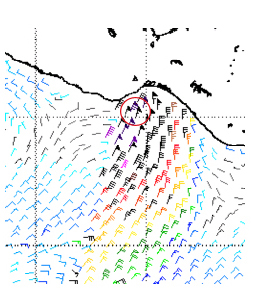

Example of hurricane force winds over Gulf of Tehuantepec
Latest information:
http://www.hpc.ncep.noaa.gov/sfc/namsesfcwbg.gif
http://www.nhc.noaa.gov/text/refresh/MIATWDEP+shtml/231523.shtml?text

http://www.nhc.noaa.gov/text/refresh/MIATWDEP+shtml/231523.shtml?text
http://www.nhc.noaa.gov/text/refresh/MIATWDEP+shtml/072204_MIATWDEP.shtml
- - - snip - - -
Update on Gulf of Tehuantepec

Foreign Minister of El Salvador Jaime Miranda (L) talks with Jose Salvador Alvarenga as the latter arrives at Comalapa airport in San Luis Talpa on the outskirts of San Salvador February 11, 2014. REUTERS/Jorge Cabrera
By Surfline/Buoyweather Chief Meteorologist Mark Willis
By now you have likely seen the media coverage of Jose Salvador’s story. If not, Jose is the famous shark fisherman that washed up on the shores of the Marshall Islands just days ago. It is estimated that he spent the last ~13 months at sea, but we don’t know for sure. When the Buoyweather meteorology team heard the news that Jose encountered strong north winds that blew him off course after departing from Paredon Viejo (within the Gulf of Tehuantepec), we immediately thought of one thing: The infamous “Tehuantepecer”.
What is a “Tehuantepecer”?
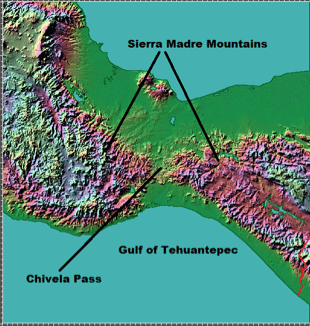
Topography of the Isthmus of Tehuantepec showing the Chivela Pass, Sierra Madre Mountains, and the Gulf of Tehuantepec. Image courtesy of John Hopkins Applied Physics Laboratory
Simply put, a “Tehuantepecer” is one of the most amazing displays of wind in the world. The term is used to describe a phenomenon that brings a narrow area of strong northerly winds to the Gulf of Tehuantepec. These wind events occur when cold fronts from the Gulf of Mexico allow northerly winds to funnel through the 40-km wide Chivela Pass, a narrow gap in the Sierra Madre Mountains in southeastern Mexico.
The “gap flow” associated with a Tehuantepecer typically produces around 12 gale force (greater than or equal to 34kts) wind events in the Gulf of Tehuantepec each cold season, most of which occur between November and March. In addition, there are typically around 6 storm force (greater than or equal to 50kts) events each year (Brennan et al., 2010).
Archived Weather Charts during the Dates in Question
Every meteorologist loves looking at chart archives during past weather events, especially when they start getting media attention like this situation. So, we decided to take a gander at Buoyweather’s historical chart archives during the two time frames that continue to be quoted in the media in reference to when the fishermen went missing: November 17-19, 2012 or December 21, 2012.
November 17-19, 2012: “Tehuantepecer 1”
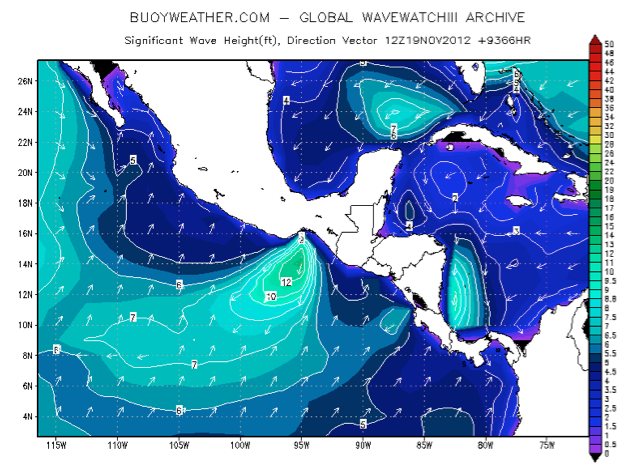
Buoyweather.com historical wave height chart for November 19, 2012 showing an area of 10-15ft seas in the Gulf of Tehuantepec.
Our archives suggest that a low end “Tehuantepecer” event occurred during this time. A strong area of high pressure that built south from the eastern half of the United States and through the Gulf of Mexico led to a narrow area of 25-35kt N winds through the Gulf of Tehuantepec during November 17-19, 2012. This was also confirmed by ASCAT satellite observed winds. Buoyweather wave data suggests that the N winds produced very short period, steep waves in the 10-15ft range during this time. In addition, a Gale Warning(issued by the National Hurricane Center’s Tropical Analysis and Forecast Branch or NHC TAFB) was in effect for this area during this time.

December 21, 2012: “Tehuantepecer 2”
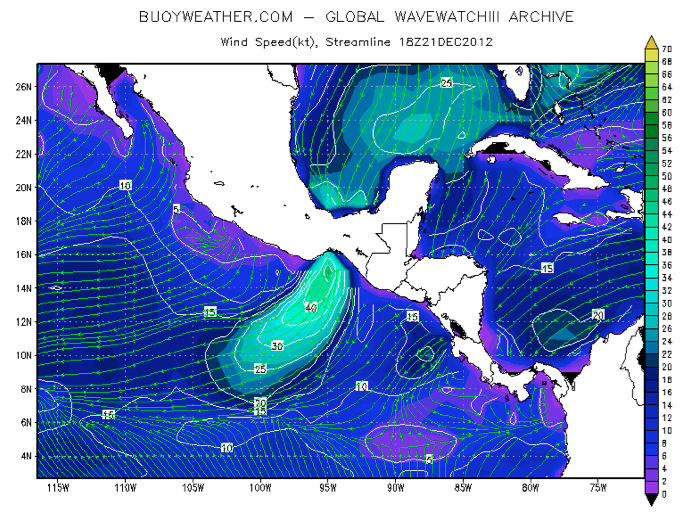
Buoyweather.com historical wind speed and streamline chart from December 21, 2012 showing an area of 35-50kt N winds through the Gulf of Tehuantepec.
Archived weather charts during the second date of interest (December 21, 2012) revealed an even stronger “Tehuantepecer” event. This event was associated with a strong area of high pressure (~1033mb) that built over South Texas behind a cold front that pushed through the Gulf of Mexico. The further south position of the post-frontal high-pressure system was key in making this event stronger than “Tehuantepecer 1” in November. While satellite observations were not readily available in this region on the 21st, Buoyweather chart archives suggested that an area of strong gale to low end storm force winds (40-50kt) were blowing through the Gulf of Tehuantepec during this time. In addition, NHC TAFB had a Storm Warning in effect on the 21st.
Did a “Tehuantepecer” lead to Jose Salvador’s Mayday?
Well, we don’t know for sure and we may never know the answer to that question. However, we are fairly confident that there were potentially very dangerous “Tehuantepecer” North wind events that occurred on both November 17-19, 2012 and December 21, 2012. These events are enough to impact any mariner, especially the storm force event on the 21st.
No comments:
Post a Comment