January 1, 2024 REVISION
Keywords: landfill leachate, coagulation, flocculation, physicochemical treatment, leachate treatment, Mexico, organic matter, COD, chemical oxygen demand, ferric chloride, ferrous sulphate
If it smells like stink... it must have stink in it...
http://www2.bren.ucsb.edu/~keller/courses/GP_reports/FinalReport_Chiapas2.pdf
http://www.udec.edu.mx/BibliotecaInvestigacion/Documentos/2009/Abril/Ing%20Challenges%20Facing%20Municipal%20Wastewater%20Treatment%20in%20Mexico.pdf
http://www.fao.org/docrep/003/x9419e/x9419e06.htm
http://en.wikipedia.org/wiki/Water_supply_and_sanitation_in_Mexico
InspectAPedia tolerates no conflicts of interest. We have no relationship with advertisers, products, or services discussed at this website.
InspectAPedia tolerates no conflicts of interest. We have no relationship with advertisers, products, or services discussed at this website.
 As our this Carson Dunlop sketch shows, a true well flow test, also called a well yield test or a well draw down test, is performed at the well, using a special pump which draws water directly from the well.
 We distinguish among water quantity (how much water can we draw from a well before we run out?), waterquality (what contaminants are present in water?), and water pressure or flow adequacy, and we list options for improving the first of these in the articles below.
 Water pressure or water flow rate in a building plumbing system describes the water quantity and water pressure delivered at individual plumbing fixtures. The in-building water flow rate or water pressure is determined by the pressure capability of the well pump, the settings of the water pressure tank control, and by the length, diameter, and clogs in building piping - not by the quantity of water available.
Water quantity describes the total amount of water available at a property served by a private well.
Water pressure or water flow rate in a building plumbing system describes the water quantity and water pressure delivered at individual plumbing fixtures. The in-building water flow rate or water pressure is determined by the pressure capability of the well pump, the settings of the water pressure tank control, and by the length, diameter, and clogs in building piping - not by the quantity of water available.
Water quantity describes the total amount of water available at a property served by a private well.
 Hot water problem diagnostic basics: If cold water pressure is adequate in the building but the hot water quantity or pressure and flow are inadequate, see these articles listed below. The sketch at left, courtesy of Carson Dunlop, shows the installation of a tempering valve at a tankless coil used for making hot water.
http://www2.bren.ucsb.edu/~keller/courses/GP_reports/FinalReport_Chiapas2.pdf
http://www.udec.edu.mx/BibliotecaInvestigacion/Documentos/2009/Abril/Ing%20Challenges%20Facing%20Municipal%20Wastewater%20Treatment%20in%20Mexico.pdf
http://www.fao.org/docrep/003/x9419e/x9419e06.htm
http://en.wikipedia.org/wiki/Water_supply_and_sanitation_in_Mexico
How to Identify & Cure Odors in Drinking Water
|
InspectAPedia tolerates no conflicts of interest. We have no relationship with advertisers, products, or services discussed at this website.
This article discusses how to identify, diagnose, and cure common odors that may be present in drinking water. We also discuss which of these odors may warn of unsanitary conditions.
"Honey - the Water Smells Funny!" - what are the causes of odors in drinking water?
Scott Bradley, Aquacheck Water Testing Laboratory
Although water as a pure compound, H2O, is colorless and odorless, contact with the earth's minerals and our distribution pipes may impart some flavor and odor characteristics.
The Threshold Odor Test Method
A subjective analysis called the Threshold Odor Test, number 2150b. in Standard Methods for the Examination of Water and Wastewater, 19th ed., can give us an idea of the strength of the odor as compared to controls of varying degree of odor concentration. But how do you interpret what the underlying problem is when your water has a peculiar odor?
Sulphur Odors in Water
Some odors are a little more insidious and require a bit of background knowledge to deal with them effectively. If your source water runs through an area where naturally occurring sulfur is present, some sulfur may dissolve into the water. We provide a diagnostic procedure to track down the source of sulphur smells in water just below.
Some of this dissolved sulfur turns to the gas, hydrogen sulfide, and this can give the water a rotten egg type smelly odor.
Sulphur odors can also be caused by a failing hot water heater component, or by certain bacteria in the building plumbing system, conditions we also discuss below.
Sulphur smells in water can also occur in rivers, lakes, streams, ponds, and can be caused by anoxia and algae which in turn may be caused by high nitrogen from agricultural runoff - a condition we discuss at WELL WATER CONTAMINANT SOURCES.
Causes of other odors and smells in buildings (not just in building water) are discussed in a series of odor diagnosis articles which are listed at the end of This article .
Since sulphur or "rotten egg" odors in drinking water are a very common complaint we'll look at this case next, continuing this article at Diagnosing and Correcting Sulphur Odors. We provide a detailed list of sewer and sulphur gas odor sources at Sources of Sulphur Odors in Buildings.
Questions and Answers About Odors in Water
Question: My client complains of a "certain smell" in her water but she can't identify it
I've got a client whose weekend home I inspected in 2005. They now have two young children and she's complaining about a "certain" smell in her water. She can't identify the smell.
Rotten eggs? No. Oily? No. Chemical? No.
But she smells it on herself and on her children after a bath or shower and says her skin fees dry after a shower.
Another twist. They've got two wells. They switch from one to the other when one gets dry. This home is in Ancramdale, NY 12503, Columbia County. Pretty rural. Lots of farming and sheep farming, I think.
The client wants me to test both wells. But I'm not confident that any generic water tests will do the job in this case. I've looked at both of your articles: WATER POLLUTANT SOURCES and Other Common Water Smells or Odors
I've looked at these two pages and I've got Smith Lab's price sheet in front of me and I think I'm in over my head. I mean, this could cost them over $1,000 in lab fees alone for the two wells.
Any suggestions? - Arlene Puentes, ASHI
Reply: Starting Point for Chasing Down Unidentified Odors in the Water Supply
- Most home inspectors, even men and women who include water testing in their services, to not consider tests for unspecified odors in water as within their scope, and indeed ASHI and other inspection standards exclude these tricky environmental questions.
- But you can recommend that your client consult with at least two independent water treatment companies. In her area she can contact Hudson Valley Water Resources - Russ Chapman. While it's our OPINION that water treatment companies indeed do want to sell water treatment equipment, still they won't make up things that are not there, and they will often agree to inspect a client's water treatment equipment and test her water at no fee.
- Also, local water testing laboratories, folks who process a large volume of water samples from their neighborhood, often can tell you (or your client) whether or not they've had odor complaints from other homeowners in the same neighborhood.
- Your client might also check these other possibilities:
- A more comprehensive starting point for tracking down smells in household water begins at ODORS IN WATER.
- There could be odors coming from a source other than water. She should consult our odor track down approach beginning atODORS GASES SMELLS, DIAGNOSIS & CURE, where we consider all common sources of odors in buildings, including water and other systems.
- Check the soaps, gels, shampoos, lotions in use because sometimes they may have a role in these complaints
Who smells the odors?
- Individual sense of smell varies widely. But if only one person observes an odor or other environmental complaint, some further investigation in an additional direction (besides the building and its neighborhood and its mechanical systems) could be helpful.
- Watch out: in some cases, particularly where there were health or aging concerns involved, sometimes these complaints are psychogenic in origin, or on occasion a person might have a health related problem that affects odors and skin sensations. Your client is not elderly, so aging-related health and odor complaints probably wouldn't apply. but if she is the only person observing the odor complaint, it's worth an effort to sort out this question:
- Is the individual observing these odors because s/he has a particularly sensitive sense of smell, or could there be an underlying health or neurological problem that has not been recognized. If there is even the slightest possibility of the second alternative, the client ought to check with her primary care physician and with that doctor, decide if a referral to a suitable neurologist is in order.
Watch out: methane odors in a building water supply can be explosive (METHANE GAS SOURCES)
How to Test Well Flow Rate & Water Quantity
|
This article describes how a home owner or home buyer can test, measure, or estimate the amount of water available from a well and how to evaluate the water pressure delivered in a building served by a private well.
How to Do Your Own Amateur Well Flow Rate/Well Yield Test
The sketch at page top, courtesy of Carson Dunlop, outlines what happens during a true well flow test, also called a well drawdown or well flow test procedure. That procedure can give an accurate picture of how much water the well can deliver, though the quantity may vary seasonally or for other reasons. But there are some steps that an amateur can take first to check on the well water quantity. In fact it's possible use mere visual inspection to form a reasonable suspicion that a building has insufficient well water before testing anything. We describe these procedures here.
Readers of this document should read our companion article, WELL FLOW RATE Also see Water Tank Types and before assuming that a water problem is due to the well itself, see Water pump and pressure tank repair diagnosis & cost an specific case which offers an example of diagnosis of loss of water pressure, loss of water, and analyzes the actual repair cost.
What is a true well flow rate or capacity test?
At WELL FLOW RATE we explained that a real well flow rate test is usually performed right at the well by the well driller or a plumber, at the time the well was drilled, and using special equipment.
A true well flow test, well recovery test, or well draw-down test requires special equipment and locating, opening, and pumping right at the well. That procedure has the advantage that the well flow rate recorded is not affected by other problems such as a piping error or clogged water pipes or a defective well pump or water pressure tank.
A rough "do-it-yourself" well flow test
But when buying a property it's reasonable to perform your own crude water flow test right in the building, so long as you keep in mind that the water pump, water tank, pump controls, and the condition of the water supply piping, the height of the building, and the condition of the fixtures (such as a clogged sink spigot strainer) are all affecting the actual flow rate you see at a fixture. What we describe below is not a true well flow test or well drawdown test but this procedure can let us know early if there is an obvious red flagalert about water quantity.
How Water Flow & Pressure Behave in a Building
The water flow rate at a building served by a pump and well will vary over time as the pump cycles on and off, and perhaps slow down or even stop completely if the well and its static head have only a limited volume of water available. The water pressure at a fixture served by a private well, pump, and pressure tank, will normally vary between the pump cut-in pressure (typically 20 psi or 30 psi) and the pump cut out pressure (typically 40 psi to 50 psi or a little higher).
If water pressure is always "ok" but varies between pretty strong and not so strong, this might be normal. Because the water pressure normally varies within this range, you may observe a modest change in water flow at an individual fixture such as a shower head or sink faucet.
If water pressure starts very strong and falls off to much slower immediately, we suspect a problem with clogged piping in the building: if the inside of a water supply pipe is blocked by mineral deposits or rust the effective diameter of the pipe is reduced, causing a reduction in water flow rate in a building even if the starting water pressure is good. Lots of people are confused about the difference between water flow rate (how many gallons per minute are coming out of a faucet) and water pressure (how hard is the water pressing inside the pipes and fixtures).
If water pressure drops way down to a very slow rate or stops entirely, there is a problem with the water pump, tank, piping, pump controls, or worst, there may be a problem with the well itself.
We explain how to diagnose loss of water pressure in detail at WATER PRESSURE LOSS .
What is a Reasonable Water Flow Rate in a Building?
Subjectively, we should be able to go to the highest bathroom or other plumbing facility in the building and run two fixtures simultaneously, seeing a reasonable water flow in which one could shower or wash. If you turn on the top floor shower and then open a sink faucet and you see the shower slow to a trickle, the building water pressure is unacceptable. If you couldn't reasonably bathe in a trickling shower flow, the flow is not functional. This usually not a water quantity problem, it's a pump, water tank, piping, or fixture problem. Usually. A well with a bad flow rate can also show up as a poor in-building water flow rate.
A typical bath sink faucet will flow around 1 gpm to 2 gpm, bath tub spout will flow at around 2.5 to 5 gpm, and a kitchen sink faucet at around 2-3 gpm. Low-flow water-saving fixtures may provide a good strong water stream but fewer gallons per minute.
Step by Step Guide to a Simple Well Yield Test that a Home Buyer or Home Owner can Perform?
Provided the home, community, and season are not in a time or area of drought and water shortage, it is reasonable to "waste" some well water for the benefit of the chance of discovery of a very important and costly water shortage at the individual well being tested. In some cases this test may be inappropriate (drought, already-failed septic field) or the owner may not permit it to be performed. If you cannot test water quantity or well yield you should not assume that you will have enough water at the property until you know more.
- Turn on water at one or more plumbing fixtures.
- Measure or estimate the flow at each fixture being run.
- Observe the well pump controls at the water tank: is the pump running continuously? If so we're continuously taking water out of the well; If not, we're taking water out of the well intermittently which we can continue to do but it's a less aggressive test and any calculations of total amount of water run will be inaccurate as a maximum well yield number. Record whether the pump was running continuously or not.
- Track the number of minutes that each plumbing fixture is run
- If available, obtain specifications on the well so that later we can calculate the volume of water in the static head in the well. Static head and its significance when testing well yield are explained at WELL FLOW RATE
- Run an estimated 150 to 300 gallons of water or at a bare minimum, 50 gallons per bedroom. More water can be run if there is no risk of flooding a septic system (if the building is connected to a municipal sewer)
- At the end of the test interval, record the results
- If the well and water supply system ran out of water calculate the number of gallons obtained before the well ran dry. (Details on how to do this are just below).
- If water pressure deteriorated or slowed significantly, record the time that this occurred; your volume calculations of water quantity taken out of the well after this point will be wrong and will over-state the well yield unless you re-estimate or re-measure the flow at each fixture.
- If the well and water supply system did not run out of water and if it did not noticeably slow down, calculate and record the total number of gallons of water obtained for comparison with acceptable water volumes. We show typical daily water usage volumes for residential properties at WATER USAGE TABLE
- Evaluate the results of your water test (see notes just below).
If you can run water in the building for a reasonable period of time at a reasonable flow rate, you can guess that you have a functional water supply system even though you don't really know how good the well is. (You could have a huge static head and a poor well recovery rate, for example, and you can't see that in the building without more investigation.)
If we can run 150 - 300 gallons of water out of a well during the few hours of a property inspection without running out of water, the water supply system is probably functional. Some authorities give a figure of 500 gallons of water as average daily usage for a family of four. Remember that water is not consumed uniformly over the day - it is usually consumed in two surges, in the morning and in the evening.
If we try to run too much water, say 600 gallons or 1000 gallons of water or more during an amateur test, (if that's even possible) we're probably exceeding the design parameters of the system. And we might flood the septic field if there is one. Such tests are unreasonable unless we know more about the well system and its purported water yield.
If water pressure and flow fell off during our test but water continued to run then we were probably running off of the actual well yield rate or well flow rate after that point of pressure/flow change. By noting the time that the flow rate/pressure changed, we can make a rough calculation of the static head in the well (only rough), and we can make a rough calculation of the well flow rate after we had drawn down the static head in the well.
How to Calculate Well Yield if We Run Out of Water During a Simple Flow Test
Calculate how many gallons of water you ran by adding up the individual fixture flow rates in gpm; multiply each fixture flow rate by the time it was running, and add up these numbers to get the total water volume we withdrew from the well.
Example of an amateur well yield test running three fixtures in a building:
- Fixture #1-bath sink: ran at 1 gpm for 32 minutes before water ran out; F1: 1 x 32 = 32 gallons
- Fixture #2-bathtub: ran at 2 gpm for 25 minutes before the water ran out; F2: 2 x 25 = 50 gallons
- Fixture #3-kitchen sink: ran at 1.5 gpm for 20 minutes before the water ran out. F3: 1.5 x 20 = 15 gallons.
Adding these up: Total Gallons of Water We Ran: 32+50+15 = 97 gallons total. Not much.
If our water supply system stopped dead with no water at the fixtures at the end of this test (we promptly turned everything off, including the pump when the water stopped flowing), our well gave us a total of 97 gallons before we ran dry.
If the well runs dry during modest use there is a problem: Even though this test is messy, if we run out of water we've got a clear, unambiguous result. We don't know how much of that 97 gallons was in the well's static head but we do know that unless we identify some other unusual problem (a broken pipe in the well or a failure of the pump itself) the well is inadequate. If this seat-of-the-pants well yield test runs out of water, there is a problem and you'll need to call in a plumber and perhaps a well expert to diagnose the problem before you know what steps need to be taken.
Watch out: if the water stops flowing, turn off the pump so it is not damaged by running dry and hot. See how long it takes for the well to recover enough for water to flow again when the pump is turned back on by trying it every half hour or so.
What to do Next if You Suspect Inadequate Water Pressure or Water Quantity
- If water pressure was poor at one or all plumbing fixtures, call an experienced plumber to help diagnose the cause of bad water pressure. Good water pressure in some locations and poor water pressure at others is likely to be a piping or equipment problem. IF all of the building water pipes are mineral-clogged, significant costs may be involved in re-piping and in providing water treatment to prevent future clogs. But before you call a plumber to look at bad water pressure at sink faucets, check to see if the faucet strainers are clogged. See WATER PRESSURE LOSS for a diagnostic guide.
- If you ran out of water early during your well flow test, call an experienced plumber or well expert to diagnose the cause of insufficient water quantity. Don't assume you have to drill a new well before careful diagnosis has been completed. Significant costs could be involved, but first let's rule out an in-well piping leak or a pump defect. take a look at WELL YIELD IMPROVEMENT.
How do We Conduct an Accurate, True Well Flow Test, Well Yield Test, or Well Drawdown Test?
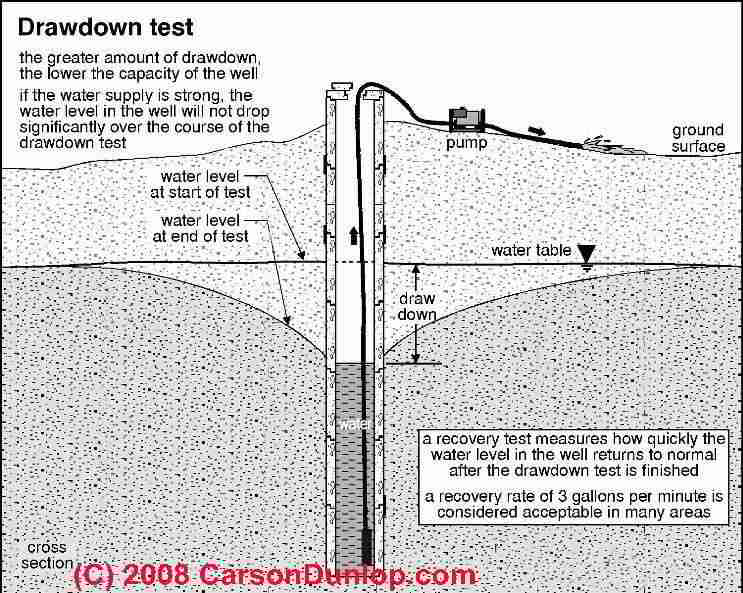 As our this Carson Dunlop sketch shows, a true well flow test, also called a well yield test or a well draw down test, is performed at the well, using a special pump which draws water directly from the well.
The inspector can vary the rate at which the pump draws water out of the well in order to determine the rate at which the well can deliver a sustained water flow rate or quantity over a measured time period, usually several hours, typically 3 hours or 4 hours, and in some cases over 24 hours.
A true well flow test or well draw down test will discover the ability of the well to deliver water, without confusion caused by the characteristics of the building's own well pump, pump control, water pressure tank, water piping, or fixtures.
All of these in-building components can dramatically affect water pressure and water flow rate in the building, and the size of the static head in a well can cause confusion between how much water is "available" at any given time and how much water the well can really deliver. We explain these factors and other reasons why the true well yield number is complex at WELL FLOW RATE
Because a true well flow test or well water draw down test requires that a special pump be attached directly to the well, this test is not normally performed during a pre-purchase home inspection. But this test should absolutely be performed if the inspection, building history, or other clues suggest that there may be a water quantity problem at the property.
Visual Clues Can Suggest that the Water Well Has Limited Capacity
Look around for other clues about water quantity: if you see lots of bottles of water stored near the water pump or water tank or even elsewhere in the building, if you see that flow restrictors are in use at every fixture, if you see a one line jet pump, any of these might be a clue that the well is unreliable or of limited capacity. Look for:
- Collections of water bottles stored by the water pump, presumably to re-prime the pump when water pressure is lost
- Large family of occupants including small children, with no dishwasher or no clothes washer installed
- Seller or realtor requests early termination of a well flow test or septic loading and dye test
- Presence of old abandoned pumps, pump parts, etc.
- Suggestions to rely on amateur or un-documented "well flow" tests that may not have been properly performed
Why is simple measurement water flow at a faucet an inaccurate test of well yield?
What about testing water flow and pressure from a well by using a flow gauge attached to a faucet? This is a "for show" measurement, not a real one - it is simply very inaccurate.
We can pretend to "measure" water flow, say at a tub spout, simply by seeing how many minutes it takes to fill the 5-gallon bucket. We can also pretend to "measure" water flow by attaching a flow meter gauge to a building faucet, typically to an outdoor spigot.
These tests are interesting but they're just pretending to measure the well - they're not really looking at the capacity of the well to deliver water. Instead this approach is really checking the capacity of the pump and piping to deliver a particular water flow rate and pressure
Lots of people do it, but we do not like nor trust most quantitative measurements of water flow at building fixturesbecause giving any quantitative number to such a flow is inaccurate. The flow at a plumbing fixture is set by the fixture itself, strainer, faucet, pipe diameter, pipe clogs, and by building piping and pump and water tank.
Furthermore, while we're running fixtures at a modest rate, the water pressure will cycle up and down between the pump cut-in and pump cut-out pressure. Since the actual water pressure is varying constantly, collecting and measuring the volume of water at a fixture during any short interval does not describe the full capability of the water supply system.
If the pump is not on we're not taking water out of the well: If water is being run slowly in a building, or perhaps just at one modest-flow fixture, the well pump will "catch up" with the demand, pressurize the water pressure tank, and the pump will turn off. The air spring in the water pressure tank keeps the water flowing out of the tank, but we're not taking any water out of the well during this part of the pump cycle.
When multiple building fixtures are running and we're taking lots of water out of the system, the well pump will usually run continuously. IF the well pump is running continuously, AND if it is not changing the pressure in the water pressure tank, then all of the pump output is going to the building fixtures and the sum of flow at all of them is probably a reasonable guess at the flow-rate capacity of the water supply system - that is, the capability of the well pump to send up water. We're still not checking the real capability of the well to deliver water - not until we connect a pump that is capable of pulling water out of the well faster than it flows into the well.
So we're not always testing the well yield when we're running the water - it depends on how fast we run the water and how long we run the water to determine if our test has even a slight chance of telling us about the actual well yield or well flow rate.
Flow Rate At a Fixture = (Time to fill the 5-gallon bucket in minutes) / 5 gallons
But faucet water flow rate is not the well flow rate - it's the flow rate of the pump and piping in the building. Don't let anyone fool you on this point. Even if we ran all building fixtures at once, kept the well pump running continuously, and measured all of the flows (to add them up) we still are only measuring what the pump is delivering, not how much water the well can provide.
Why do these pretend tests then? Because we might run out of water early - showing that there is indeed a well capacity or water quantity problem.
Not one of these measurements accurately describes how much water is available at the well. All we're seeing is whether or not the water system is producing functional pressure and flow rate; we're not seeing how much water is in the well.
So what can a home buyer or home owner do to estimate well yield before going to the cost and trouble of hiring a well-testing company for a true well draw down test or well recovery test?
What's the Difference Between Inadequate Water Quantity & Bad Water Quality?
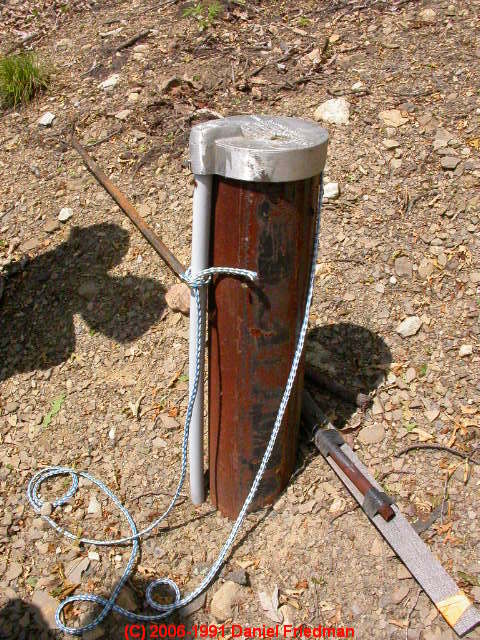 We distinguish among water quantity (how much water can we draw from a well before we run out?), waterquality (what contaminants are present in water?), and water pressure or flow adequacy, and we list options for improving the first of these in the articles below.
Our photo (left) shows a modern drilled well with a six-inch steel casing and electrical conduit entering the well cap - telling us that this is a deep well whose pump is installed inside the well itself. But from just a visual inspection of the well we have no idea how much water can be drawn from this system. This article explains how to determine the water quantity available at a property, how to diagnose inadequate water quantity (or alternatively poor water pressure and flow), and how to correct those conditions.
If your concern is for the quality of drinking water (contaminants, odors, etc) see WATER QUALITY TESTS, CONTAMINANTS, TREATMENTand the diagnostic suggestions listed there. Our page top photo shows a very large water storage tank - a system that is installed when the well flow rate at a property is very limited. By using a large water storage tank the building occupants can have plenty of water for regular use. The tank is filled, slowly, during periods when water is not being drawn from the system.
If the Water Pressure is Too Weak in a Building
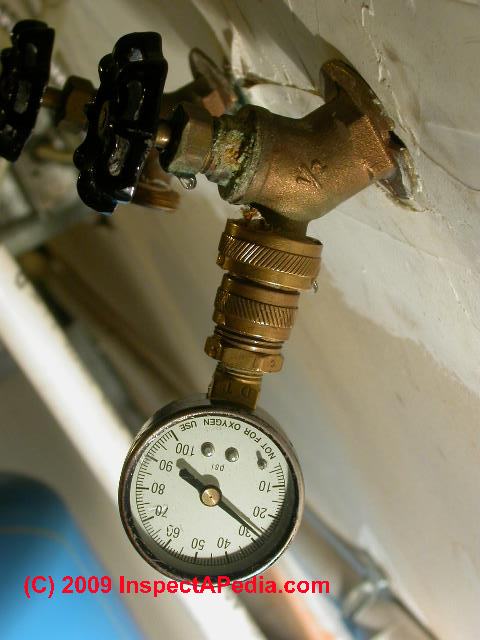 Water pressure or water flow rate in a building plumbing system describes the water quantity and water pressure delivered at individual plumbing fixtures. The in-building water flow rate or water pressure is determined by the pressure capability of the well pump, the settings of the water pressure tank control, and by the length, diameter, and clogs in building piping - not by the quantity of water available.
WATER PRESSURE LOSS DIAGNOSIS & REPAIR - a description of the procedures used to diagnose the cause of poor water pressure or the cause of running out of water entirely at a property served by a private well
- WATER PRESSURE & FLOW MEASUREMENT - how can we measure water pressure and flow in a building?
- Water Pressure Intermittent - what does it mean if water pressure comes and goes at a property?
- No Water Pressure - what to do if water pressure is lost entirely
- Well Tank relation to Water Pressure - what are the functions of a water pressure tank and how does it affect water pressure in the building?
- Shaking the Water Tank? - a quick simple way to find out if there is water in the water tank
- WATER PRESSURE TANK REPAIRS - causes of problems with the water tank
- Water Pressure Tank Diagnosis - how to determine what's wrong with the water tank
- Water pressure Later Returns "on its own" - more details about intermittent water pressure and what to do about it
- Water pipe clog diagnosis - how to determine if building piping is responsible for bad water pressure and flow
- Water pipe clog repair guide - what to do about clogged building water supply piping
- WATER PRESSURE REPAIR CORRECTLY? - how do we know we have made the correct repair while avoiding unnecessary water system costs
- Typical Water Tank & Pump Price
- Questions about lost water pressure
- Advice to a homeowner
- Adjusting Water Pump Pressure Control - how to adjust building water pressure at the pump or water tank
- WELL PUMP / TANK REPAIR ADEQUACY
- Well Pump & Tank Replacement Costs
- Reliability of Pump & Tank Repairs
- WATER PUMP PRIMING PROCEDURE - how to get the water pump working again
- WATER PRESSURE REDUCER / REGULATOR - how to adjust a municipal water pressure regulator
If the Well Water Quantity is Insufficient at a Property
Water quantity describes the total amount of water available at a property served by a private well.
The total amount of water available is the sum of the static head in the well (the water inside the well casing or well itself when the well is at rest), the water stored in piping and in water pressure or water storage tanks, and the well flow rate (the rate at which water flows into the well).
If you run out of water at a property this means that you have drawn off all of the static water storage and that the rate at which water flows into the well is less than the rate that the pump is trying to send water out of the well and into the building.
Well flow rate or well yield is the rate at which water flows into the well from surrounding rock and ground water sources. The flow rate of a well is a complex number - water enters the well from various rock cracks or fissures at different depths. The sketch at left, courtesy of Carson Dunlop, outlines what happens during a well drawdown or well flow test procedure.
At each point where water enters the well the rate of water flow may vary over time, and may slow or even stop as water is drawn from the well. When a new well is drilled the well driller measures the actual flow rate of the well (the sum of all of these individual flows) by using a calibrated pump installed right at the well itself.
Well depth does not tell you much directly about the ability of the well to deliver water (the well yield or well flow rate). Rather, the depth of an individual well was determined by the well driller who drilled ever deeper until the well flow rate appeared to be adequate (typically 5 gpm or better for new wells). However a very deep well probably indicates that the driller had to do a lot of drilling to hit an adequate water supply.
- WELL FLOW RATE - we describe the well flow rate and water quantity of a well, including well flow rate, static head, and the effects on well yield when we install a new more powerful well pump.
- WELL QUANTITY FLOW TEST PROCEDURE - we describe how to test the ability of a well to deliver water
- WELL YIELD IMPROVEMENT - we describe how to increase the water flow rate or quantity from a well - improving the well yield
Hot Water Problems & Solutions
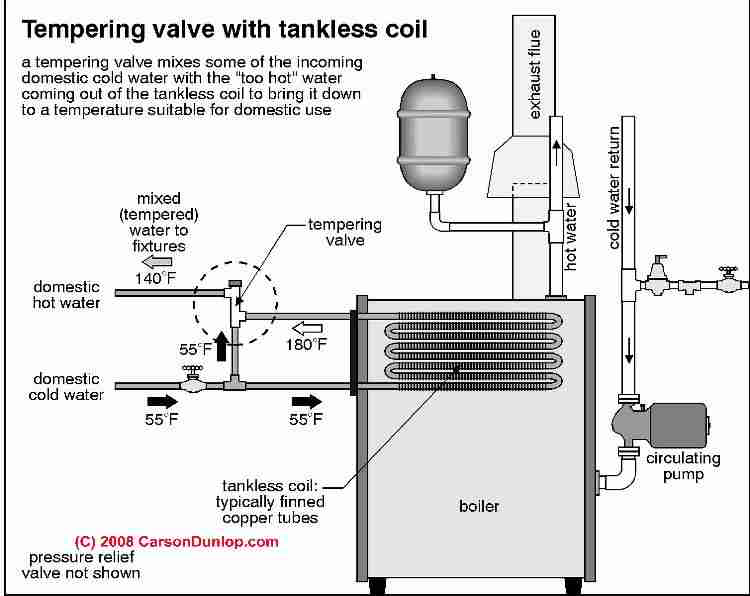 Hot water problem diagnostic basics: If cold water pressure is adequate in the building but the hot water quantity or pressure and flow are inadequate, see these articles listed below. The sketch at left, courtesy of Carson Dunlop, shows the installation of a tempering valve at a tankless coil used for making hot water.
A useful water pressure and flow diagnostic in a building is to compare the hot water pressure and cold water pressure at individual fixtures.
If hot water pressure and flow are the same as cold water pressure and flow at some fixtures but at others the hot water flow rate is less, we suspect a local problem with the piping, faucets and valves at the fixture.
If hot water pressure and flow are poor throughout the building, the problem could be at the hot water source or in the building piping.
- HOT WATER IMPROVEMENTS - how to get more hot water pressure, flow, or temperature in a building
- HOT WATER DELIVERY SPEED UP - how to get hot water more quickly at a plumbing fixture
- HOT WATER QUANTITY IMPROVEMENT - how to increase the amount of hot water at a property
Water Quality - is the Water Safe to Drink, Contaminated, Smelly, Discolored, Sedimented?
Water quality describes what is in the building water supply: contaminants,odors, etc. If your concern is for water quality (contamination, odors, water tests, water treatment) see these articles:
- WATER TESTS, CONTAMINANTS, TREATMENT
- WATER TEST CHOICES & WATER TEST FEES
- WATER TESTING GUIDE
- WATER TREATMENT EQUIPMENT CHOICES
- FAQs below discusses field reports of problems & solutions for this topic
- Related Topics, found near the top of this page providers a complete list articles closely related to this one.
Check back... more to follow....
No comments:
Post a Comment